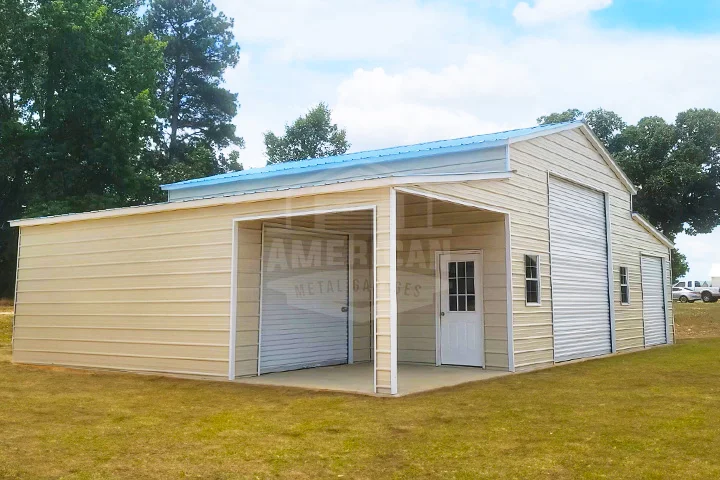





Choosing the Right Roof Style for Your Metal Building
- “Will a Regular roof work where I live?”
- “Is the A‐Frame worth the upgrade?”
- “Do I need to invest in a Vertical roof?”
Choosing the right roof style for your metal building is a crucial decision that impacts everything from durability to maintenance. Whether you’re building a steel garage, workshop, or barn, this decision shouldn’t be made lightly.
There’s no single “best” option for everyone. It comes down to understanding what each style is designed to handle and matching that to your location, use, and long-term expectations.
Let’s go through each style in detail.
Regular Roof – Standard Option for Mild Weather
The Regular Roof is considered the base-level style for many entry steel garages and carports.
Its framework uses rounded corners, and the roof panels run horizontally from front to back. The design is simple, cost-effective, and quick to install. It’s perfectly suitable for areas with light wind and minimal snow. The curved edges give it that classic carport appearance you’ve seen across the southern U.S.
Key Details of the Regular Roof:
- Galvanized Frame for rust protection and stability
- Curved Roofline that transitions into the sides
- Horizontal Panels for basic rain coverage in mild climates
Expert Note: I don’t usually recommend this style in northern climates. In southern states, it’s fine. In snowy areas, the maintenance will outweigh the savings. In snowy areas, the horizontal panels on a Regular roof can trap snow, which increases the risk of damage over time. Snow accumulation can weigh down the roof, causing it to sag or even collapse. In such conditions, it’s better to go with a Vertical Roof, which allows snow and debris to slide off naturally.
Additional Information:
Most manufacturers recommend not using Regular Style Roofs for buildings longer than 36 feet. This is because the longest panel that can be placed horizontally on a Regular Roof—or any roof, for that matter—is 36 feet. When panels are bolted together on a Regular roof-style building longer than 36 feet, it can lead to leaks. The connection between panels may not provide a sufficient seal, which can cause water to seep through. If your structure requires a longer span, you may need to consider other roof styles to avoid these potential issues.
A‐Frame Horizontal (Boxed‐Eave) Roof – Traditional Profile With Stronger Frame
The A‐Frame Horizontal Roof—often called Boxed‐Eave—offers a more squared-off roofline that resembles a traditional house or shop roof.
Its framing is stronger than the Regular Roof, with the peaked shape giving it a cleaner architectural look. Panels still run horizontally along the slope, so runoff performance is similar to the Regular style.
This roof works well where appearance matters and where the weather is moderate.
Key Details of the A‐Frame Horizontal Roof:
- A‐Frame Truss Design for extra rigidity
- Boxed‐Eave Finish for a squared, finished appearance
- Horizontal Panels that work best in moderate weather zones
Expert Note: I recommend this style for states like Kentucky, North Carolina, and Oklahoma. It’s a good balance for those wanting both style and strength without jumping to Vertical pricing.
Vertical Roof – High-Performance for Harsh Conditions
The Vertical Roof is the most durable option available for standard steel buildings. It takes the A‐Frame structure and installs the panels vertically from the ridge to the eaves. This orientation, combined with additional purlins and bracing, is engineered to handle heavy snow loads, strong winds, and coastal rainstorms. Snow and debris naturally slide off, reducing maintenance.
Key Details of the Vertical Roof:
- Vertical Panel Orientation for quick drainage
- Extra Bracing & Purlins for higher load capacity
- Ridge Cap & Trim for additional sealing and longevity
Expert Note: For mountain states, northern climates, or coastal regions, Vertical is my default recommendation. It saves customers headaches years down the road. In a Vertical Roof, purlins (horizontal support beams) and bracing (structural supports) help distribute the weight of heavy snow or high winds. This added strength makes the roof more resilient during extreme weather events, reducing the risk of costly repairs in the future
Roof Style Reference Guide
| Roof Style | Panel Layout | Strength | Ideal Conditions | Price Tier |
|---|---|---|---|---|
| Regular | Horizontal front-back | Basic | Warm, low-wind areas | $ |
| A‐Frame Horizontal | Horizontal side-side | Moderate | Mild–Moderate climates | $$ |
| Vertical | Vertical ridge-eave | High | Snow, wind, storms | $$$ |
Making the Right Choice
When I help customers choose, we look at three things:
- Weather patterns where the building will sit
- Intended use and how permanent the structure will be
- Upfront budget versus future maintenance
-Regular Roofs are fine in warm, calm climates.
-A‐Frame Horizontal gives more strength and better aesthetics for moderate conditions.
-Vertical is the go-to for long-term durability in challenging weather.
Expert Note: In 10+ years, I’ve never had anyone complain they chose too much roof. But I’ve had plenty wish they’d stepped up one level when the first big storm rolled through.
American Metal Garage: Built Right From Day One
At American Metal Garage, every building we install is designed with the right roof style from the start. We don’t just put up walls and a roof — we match the structure to your site, climate, and long-term needs so it holds up for decades.
Whether you’re ordering a garage, workshop, barn, or custom structure, we’ll help you choose the right roof style before installation so you get the performance you expect.