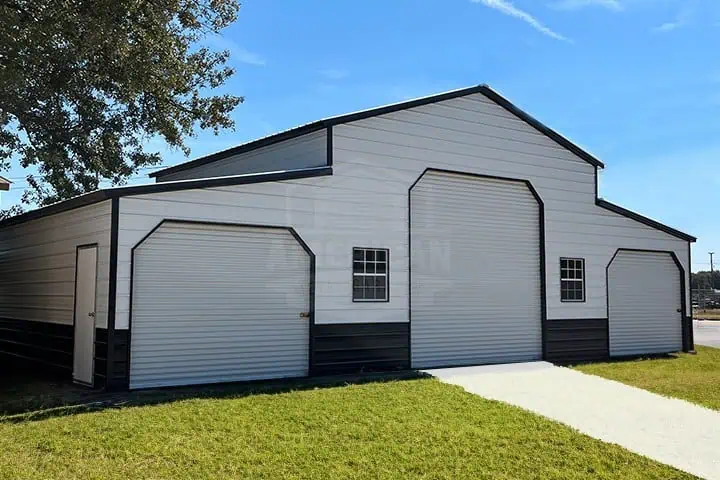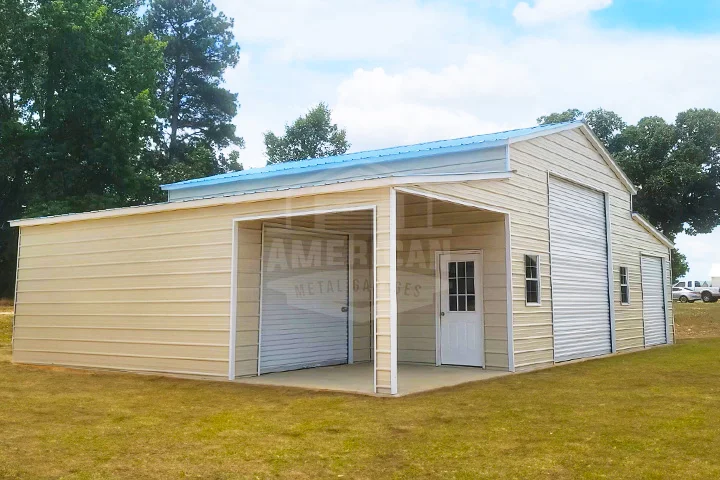

On paper it’s just numbers. On a pad, it’s different. A 40×60 starts feeling “commercial” the minute you stand inside a framed shell and realize you can stage jobs, park equipment, and still walk straight through without sideways shuffling. The 14’ height helps too—but only if you plan doors and clearance the right way. Most folks don’t measure door clearance until it’s too late, and that’s when the budget starts doing backflips.
Direct answer
A 40x60x14 commercial steel building is a 2,400 sq ft metal structure with 14-foot eave height commonly used for contractor shops, light service bays, small warehouses, and fleet/equipment storage. It’s popular because it gives you workable layout options and enough height for taller vehicles and storage—if you plan the door sizes, headroom, slab design, drainage, and access lanes before you order anything.
Quick checklist (make these calls before pricing gets real)
- What’s the tallest thing going inside with racks, ladders, or rooftop gear?
- Are you pulling in trailers—do you need drive-through or is backing out fine?
- How many bays, and what bay width do you want: 10′, 12′, or 14′?
- Door plan: 12×12 vs 14×14, and do you need high-lift hardware?
- Slab use: light storage, forklift traffic, vehicle lifts, heavy equipment?
- Roof style: gable or single-slope—and where does water dump?
- Insulation plan: heated/cooled, or just condensation control?
- How much apron/turning room do you have outside the doors?
How big is a 40x60x14, really?
The easy part: 40 x 60 = 2,400 square feet.
The part people don’t realize until the frame’s standing is how that space behaves.
- The 40-foot width controls how many bays make sense and whether you can add an office without making the shop feel pinched.
- The 60-foot length gives you depth for vehicles plus space behind them for toolboxes, benches, storage racks, or a staging lane.
- The 14-foot eave height is solid for commercial. It gives you room for taller vehicles, overhead utilities, and better air volume—without paying for extreme height you don’t need.
Quick reality check: eave height is sidewall height, not the peak. If you’ve got a gable roof, the center is taller, but doors and tracks still live in real framing, with real headroom limits.
What you can actually do in a 40×60 commercial metal building
Contractor shop + materials storage
This is the bread-and-butter use case. You can park trucks inside, keep materials dry, and stop wasting time hunting for stuff. The key is keeping the floor open enough that you can unload, stage, and load back out without doing a dance.
Most folks underestimate how much space gets eaten by “in-between” stuff—returns, scrap, empty pallets, and the pile you swear you’re dealing with Friday. Plan a lane for it or it’ll take over.
Light service bays (auto/light truck/equipment)
You can do a shop layout in this footprint easily, but bay width decides whether you like your building.
- 10-foot bays: you can work, but you’ll feel tight every day
- 12-foot bays: comfortable for most commercial work
- 14-foot bays: forgiving (especially for trucks and equipment)
If you’re even thinking about lifts, that needs to be decided early because slab and overhead clearance aren’t “we’ll figure it out later” items.
Small warehouse / light distribution
A 40×60 can work great as a small warehouse if you plan aisle space and access. Racking eats floor fast. So does staging. If you’ll use a forklift or even a pallet jack regularly, the building needs to be laid out like a warehouse, not like a garage with shelves.
Fleet and equipment storage
For work trucks, skid steers, enclosed trailers, small excavators—this size is a solid fit. Where people get burned is door approach. The building can be perfect and still feel wrong if every trailer entry is a three-point turn with tight margins.
Layouts that work (and the ones that will annoy you forever)
A good layout feels “easy” on day 200, not just day 2.
Bay planning that behaves in real life
On a 40-foot width, common workable setups are:
- 3 bays at 12’ wide = 36’ (good balance, still workable)
- 2 bays at 14’ wide = 28’ (leaves room for storage lane, parts wall, wash area, compressor closet)
Depth-wise, the 60-foot run is your friend. A full-size pickup is often 19–22 feet long. Add a bench behind it, a toolbox on the side, and you’ll understand why the extra length matters.
A layout I recommend a lot (because it runs smooth)
If the site allows it, I like overhead doors on the 60-foot sidewall. You get a longer approach line and easier turns—especially with trailers.
Inside, keep your setup simple:
- storage and racks down one long wall
- clear drive aisle through the middle
- work zones that don’t block each other
If you need an office, keep it honest. 12’ x 20’ is plenty for an office/restroom/break corner combo when it’s planned right. Bigger is fine too—just don’t steal the best bay wall to build a “future conference room” that never gets used.
The “fits vs functions” trap
People love asking, “How many vehicles can fit?” You can cram a lot in almost anything if you pack it like a storage unit.
A standard parking stall is roughly 9’ x 18’. A comfortable interior aisle for turning and breathing is often 20’+ depending on what you’re moving. If you want the building to work like a shop, you plan for movement, not maximum stuffing.
Doors, headroom, clearance: where the expensive mistakes happen
Most folks don’t measure door clearance until it’s too late. They hear “14-foot” and assume tall doors are automatic.
Overhead doors need headroom for tracks, springs, openers, and framing. Door height is a design decision tied to how the building is engineered and how the door hardware is set up.
Simple door guide for commercial use
| Door Size (WxH) | Fits What | Notes |
|---|---|---|
| 10’ x 10’ | pickups, small vans | tight for enclosed trailers/racks |
| 12’ x 12’ | most work trucks, skid steers | best all-around commercial door |
| 14’ x 14’ | box trucks, taller equipment | plan headroom + track early |
| 16’ x 14’ | wide trailers, easy entry | needs wall space + strong framing |
Quick jobsite story: I had a customer insist a 10×10 was “standard” for his service van. It cleared—barely. Two weeks later he added a ladder rack and now it didn’t clear. That reframing conversation isn’t fun for anyone. Measure vehicles with the attachments you actually run.
Door placement matters as much as door size
If you don’t have apron space and a clean approach line, even a big door becomes a pain. A good door in the wrong spot is still a bad decision.
Roof styles and structural options that matter in commercial builds
Gable roof
The most common choice for a reason. It sheds water well, gives you peak height, and vents easily.
Single-slope roof
Great when the lot or drainage dictates one-direction shed, or when you want one taller wall for clearance, signage, or a certain interior plan.
Clear-span vs interior columns
In a 40-foot width, clear-span is usually the right call for commercial use. Interior columns become obstacles—especially if you have forklifts, trailers, or you ever want to reconfigure bays later.
Panels, durability, and real-world abuse
Commercial metal buildings get bumped. Ladders lean. Wind shows up sideways. If you’re in high-wind areas, coastal humidity, or you know your building will live a rough life, it’s worth choosing options that hold up. It’s cheaper to build durability once than to “fix cheap” forever.
Slab and site prep: what decides long-term performance
Steel can go up fast. Concrete and prep are where schedules slip and budgets get surprised.
Slab needs depend on use:
- light storage is one thing
- forklifts, lifts, pallet racks, heavy equipment point loads are another
A practical way to think about it: design the slab around the heaviest reality you expect, not the lightest version of your plan.
Drainage is another big one. If your downspouts dump at overhead doors, you’ll get puddles, slab staining, ice in winter, and water creeping under thresholds. Grade the site so water runs away from doors and route roof water somewhere it can’t chew up your apron.
Insulation and condensation (even unheated buildings can sweat)
If you heat or cool the building, insulation affects comfort and operating cost. If you don’t heat it, condensation can still be a problem—warm moist air hits cold metal and suddenly it’s “raining” inside.
Hot/humid regions need better moisture planning. Cold climates need better door threshold and apron planning because freeze-thaw will punish sloppy drainage. Coastal areas need corrosion awareness. You don’t need to overcomplicate it—you just need a plan that matches how you’ll use the building.
Cost: starting price vs installed budget (straight talk)
A 40×60 building package starts at $36,361.00 with American Metal Garages. What most people really want is the installed number, and that depends on slab, site prep, and labor in your area. As a simple planning range, many owners budget a 2,400 sq ft slab at $14,400–$28,800 and erection labor at $16,800–$36,000, then add doors, insulation, interior liner, electrical, and permits based on how “commercial” the finish needs to be.
| Cost Bucket | Planning Range | What changes it |
|---|---|---|
| Building package (starting point) | Starting at $36,361.00 | loads, roof style, door package |
| Concrete slab (2,400 sq ft) | $14,400–$28,800 | prep, rebar, thickness, fill |
| Erection labor | $16,800–$36,000 | complexity, height, local labor |
| Finish items | varies | doors, insulation, liner, electrical |
Common mistakes I see (and they’re all avoidable)
- Picking door height without thinking about headroom, tracks, and openers
- Not leaving enough apron/turning room, then fighting trailers forever
- Building too much office and not enough workable shop
- Skipping gutters/drainage planning, then paying for concrete repairs later
- Pouring a light slab, then deciding you want heavy use after the fact
- Forgetting man-door placement, so you’re opening overhead doors nonstop
FAQs
How much does a 40×60 metal building cost?
A 40×60 commercial building package starts at $36,361.00 with American Metal Garages. What most people really want is the installed number, and that depends on slab, site prep, and labor in your area. As a simple planning range, many owners budget a 2,400 sq ft slab at $14,400–$28,800 and erection labor at $16,800–$36,000, then add doors, insulation, interior liner, electrical, and permits based on how “commercial” the finish needs to be.
Is 40×60 a big shop?
For most small commercial operations, yes. 2,400 sq ft gives you room for bays, storage, and staging—if you don’t waste it. It only feels small when the office eats the floor or the doors are placed wrong and you’re constantly moving vehicles around just to work.
How many cars can fit in a 40×60 garage?
A 40’ x 60’ building is 2,400 sq ft, and it will hold about six cars or trucks comfortably if you’re parking with normal walking space and door swing. If it’s a working garage with shelves, a bench, tool chests, or you want a clean drive aisle (which makes life way easier), planning for 4–5 vehicles keeps it functional instead of jammed.
What size overhead door should I put on a 40x60x14 building?
A 12’ x 12’ overhead door is the most common “works for most commercial use” choice. If you’re bringing in box trucks, taller equipment, or you want more forgiveness, 14’ x 14’ can make sense—just plan headroom and framing early so the door hardware doesn’t box you in.
How many bays can you fit in a 40×60 building?
Most practical layouts land at 2 or 3 bays that feel good to work in. Three bays usually means 12’ wide each. Two bays at 14’ wide feels roomy and leaves space for storage lanes and parts walls. You can squeeze more bays, but tight bays get old fast in real use.
Can a box truck fit in a 40x60x14 steel building?
Often yes, but it depends on the door opening height and your truck’s real height with rooftop gear. Box trucks can surprise people. Door width and approach angle matter too—if you can’t line up cleanly, even the right door size can feel like a chore.
Do I need insulation for a 40×60 commercial steel building?
If you’re heating or cooling it, insulation matters for comfort and operating cost. Even unheated buildings can sweat in humid or swing-temperature climates, so some form of condensation control is smart if you’re storing tools, inventory, or anything that hates moisture.
Do I need a permit for a 40×60 commercial steel building?
Usually yes. Commercial use typically requires engineered drawings, a site plan, setbacks, and code load requirements (wind/snow). Some areas also look at driveway access and drainage. It’s worth checking early so you’re not redesigning after materials are ordered.
Final Thoughts: Choose the Space That Serves You
If you want help planning a setup that actually fits how you work, our building experts at American Metal Garages can walk you through it without overselling anything. So are you ready to design your perfect space? Let’s do it.