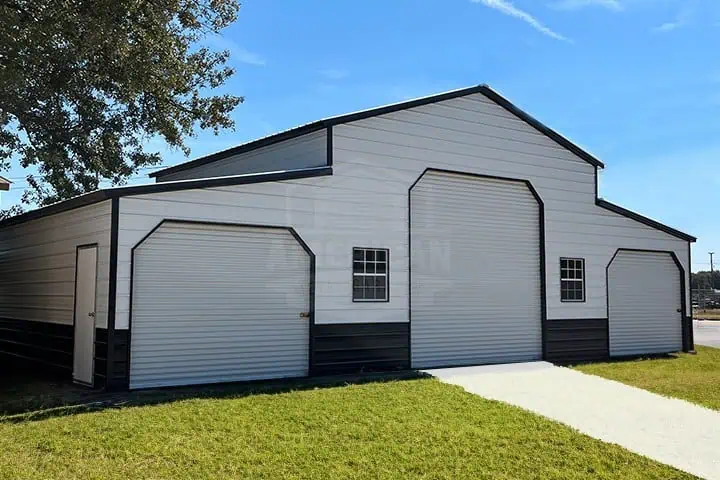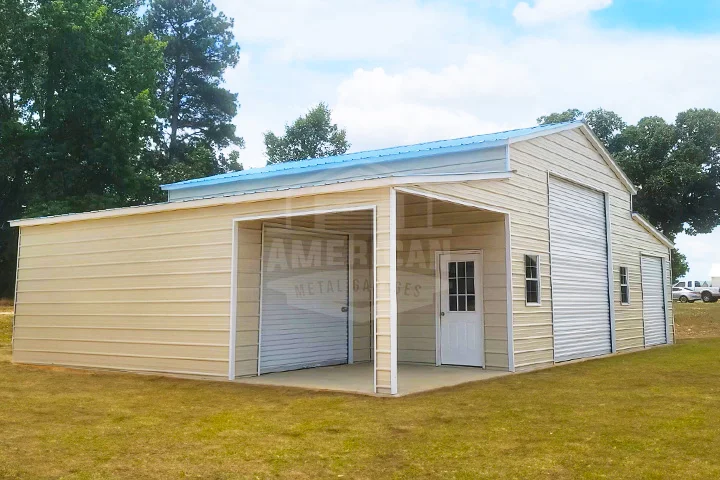


Before building a metal garage, make sure it fits real-life clearance, weather, and how you’ll use the space—not just the footprint on a quote.
The big seven are: door sizes and door type, interior height/headroom, usable layout (width/span), roof style for snow/rain/wind, steel gauge and framing strength, site prep and slab accuracy, and the cost add-ons (permits, anchors, insulation, electrical) that turn a “kit” into a finished garage.
Fast Checklist
- Measure your tallest vehicle as-is (rack, lights, antenna) and add 12–18 inches of clearance.
- Pick doors based on how you enter (straight vs angled) and what you’ll store (truck, trailer, RV, side-by-side).
- Choose width/span so you can open doors fully, walk around, and still fit a bench or shelves.
- Match roof style to your weather: runoff, snow load, wind, and where that water will go on your lot.
- Don’t guess on steel: pick panel gauge + framing that matches your span and local loads.
- Get the base right: drainage, compaction, and a slab that’s square and level.
- Budget for the “real world” items: permits, anchors, insulation/condensation control, electrical, lighting, and ventilation.
The Real Contractor Breakdown
1) Doors: “I just need a garage door.”
This is where most regrets live. People order a building size first, then “pick a door that sounds normal.” Next thing you know, the mirrors barely clear, the top seal scuffs the rack, or the opening works only if you drive in perfectly straight like you’re taking a driving test.
What I measure before I recommend a door:
- Height on level ground, including roof racks, light bars, antennas, and whatever you forget is up there.
- Width including mirrors (and whether you’re backing in at an angle).
- Your driveway/apron slope. A slope can change how a tall vehicle “presents” at the opening.
Door type matters too:
- Sectional overhead doors can seal nice, but they need interior headroom for tracks/springs.
- Roll-up doors are tough and clean for metal buildings, but you still need correct framing above.
- Double swing doors work for storage, but wind will remind you who’s boss.
Here’s a quick door-size guide I use when someone says, “Just tell me what works.”
| Door Size (W x H) | Usually Fits | What People Forget |
|---|---|---|
| 8′ x 7′ | Small cars, tight sites | Feels cramped fast; mirrors get close |
| 9′ x 7′ | Cars/light SUVs | Racks and taller tires turn “fine” into “oops” |
| 9′ x 8′ | Full-size trucks, most homeowners | Best everyday comfort choice |
| 10′ x 8′ | Wider trucks, easier backing | Needs proper opening framing—don’t cheap out |
| 10′ x 10′ | Taller rigs, small trailers | Watch interior headroom and door hardware space |
2) Height: “I’m not building a shop… but I might work in there.”
That “might” is the kicker. An 8′ sidewall can be fine for basic parking and storage. But if you want bright lights, hanging storage, a future lift, or you work on trucks, 8′ starts feeling like you’re wearing the garage like a hat.
A simple way to think about sidewall height:
- 8′: basic parking, light storage, mild expectations.
- 10′: trucks, better door options, more comfortable workspace.
- 12′ and up: lifts, tall doors, trailers, serious shop feel.
3) Width/Span and Layout: “I want room for two vehicles and a bench.”
A footprint can look big on paper and still feel tight in real life. What matters is usable lanes—vehicle lane, walking lane, work/storage lane. Here’s the mistake I see all the time: someone sizes the building to fit the vehicles, not to use the space. Then the first week they realize doors don’t open comfortably, the bench blocks walk space, and shelves eat into the parking lane.
My “real-life layout” rule:
If you want a bench wall, you’re not just adding 24″ of bench. You’re adding bench depth + shelf depth + the space your body needs to work there.
Span matters because it affects structure. Wider buildings often need stronger framing design, especially in wind or snow areas. That’s not sales talk. That’s just how wide roofs behave.
Quick sizing guidance (field sense):
- 18’–20′ wide: one vehicle + storage (or a tight “two small cars” situation).
- 24′ wide: common “two-car” starting point, but still plan carefully.
- 30′ wide: two vehicles + better work space feels possible.
- 40′ wide: shop vibes, multiple bays, room to move.
Bottom line: Don’t buy square footage. Buy workflow. Imagine opening doors, walking around, rolling a toolbox, and carrying a ladder without banging into things.
4) Roof Style: “I don’t care what roof it is… I just want it to hold up.”
Good. That’s the right attitude. Roof choice is about weather and water. If you’re in a place with real snow or heavy rain, you want a roof style and pitch that sheds well
and doesn’t dump water into problems around the base. Most folks run into trouble when runoff wasn’t planned. I’ve seen clean installs turn into muddy trenches because roof water dumps right where it shouldn’t.
Common roof styles people choose:
- Regular/rounded roof: works in mild climates, but not my first choice for heavy snow.
- A-frame/boxed: good all-around look and runoff.
- Vertical roof: usually best for shedding water/snow and keeping things cleaner long-term.
Bottom line: Pick the roof for your climate first. Looks come second.
5) Steel and Framing: “Metal is metal… right?”
Not really. Two buildings can look similar from 20 feet away and behave totally different in a storm, a hail event, or just daily wear (leaning ladders, bumping panels, mounting lights, adding vents later).
Panels (gauge) in plain terms:
- You’ll commonly see comparisons like 26-gauge vs 29-gauge panels.
- Lower gauge number is thicker steel.
- Thicker panels generally resist dents better and feel less “tinny.”
Framing matters as much as skin. Wider spans, taller walls, bigger doors, and local wind/snow loads all push framing requirements.
And real garages grow “extras” over time: fans, mini-splits, vents, cameras, lights. Stronger material handles penetrations and mounts better without feeling flimsy.
Bottom line: If you want a true garage you’ll keep for years, don’t treat steel choices like a throwaway line item.
6) Site Prep and Slab: “Just put it on a pad.”
This is where projects go sideways. A metal building wants clean geometry. If the slab is out of square or not level, the building can still go up—but you’ll see the fight in
door alignment, trim gaps, panel fit, and water behavior at the base.
What I want figured out before install day:
- Access: can delivery get in without sinking or taking out a fence?
- Drainage: water should move away from the building, not collect along the edge.
- Compaction: soft base leads to settling; settling leads to cracks and doors acting weird.
- Square + level: even small errors show up once the frame is bolted down.
Also, don’t ignore the “paperwork reality”: setbacks, permits, HOA rules, frost depth, and underground utilities. Those things don’t care that you already ordered the building.
Bottom line: The garage only sits as straight as what you build under it.
7) Cost Drivers: “The building price looks great… then the total jumps.”
Yep. That’s normal. A lot of quotes show the structure price. Most homeowners are imagining a finished garage: secure doors, lighting, power, maybe insulation,
maybe ventilation, maybe a clean interior. That’s where the real-world total comes from.
Here’s what usually moves the number:
- Sidewall height and overall size
- Roof style
- Door quantity and door sizes
- Windows, walk-in doors, framing around openings
- Slab/foundation work and anchoring
- Insulation and condensation control
- Electrical, lighting, ventilation
- Site difficulty (tight access, grading, delivery)
| Upgrade / Choice | Adds Cost | Best For |
|---|---|---|
| Taller doors/sidewalls | Medium–High | Trucks, trailers, future lift |
| Vertical roof | Medium | Snow/rain climates, easier long-term runoff |
| Extra width | Medium–High | Workbench wall, storage lanes, shop workflow |
| Insulation + ventilation plan | Medium–High | Workshops, condensation control, comfort |
| More/larger openings | Medium | Better access, cross-breeze, usability |
| Stronger design for local loads | Varies | Wind/snow regions, wide spans, inspections |
Bottom line: Set your “must-haves” first (fit, height, roof, base). Then choose comfort upgrades with whatever budget is left.
FAQs
What size metal garage do I need for two cars?
If you want two cars and you want to open doors comfortably, plan wider than the bare minimum. Add room if you want shelves or a bench.
Is a 9×7 garage door big enough for a truck?
Sometimes, but it can be tight. A lot of full-size trucks feel better with 9×8, and taller doors are safer if you have racks, bigger tires, or a tall trim package.
How tall should a metal garage be if I want a lift later?
Plan height early. Lift model, vehicle height, overhead clearance, lights, and door tracks all stack together. You want margin, not a tight squeeze.
Roll-up door or sectional door for a metal garage?
Either can work. Sectional doors need more interior headroom for tracks/springs. Roll-up doors are clean and tough, but still need correct framing above the opening.
Do I need a concrete slab for a metal garage?
Not always, but a properly planned slab makes anchoring, drainage, and day-to-day use much better—especially if you’re parking vehicles or working inside.
How do I stop condensation in a metal garage?
Treat it like a moisture-and-temperature problem. Insulation helps, ventilation helps (ridge/vents or planned airflow), and a vapor barrier may matter depending on how you finish the interior.
What roof style is best for snow and heavy rain?
A roof that sheds well makes ownership easier, especially in snowy or wet climates. The best choice still depends on local requirements and your site runoff plan.
What do people forget before ordering a metal garage?
Door clearance with a sloped approach, slab being out of square, and budgeting for electrical/lighting/insulation that turns it into a usable space.
Wrap-up
A metal garage is a great investment when it’s sized for real life: how you park, what you store, where you work, and what you might buy next year. Nail the clearance, the layout, the roof choice for your weather, and the base prep. Those are the decisions that keep you from paying twice. If you want help planning a setup that actually fits how you work, our team at American Metal Garages can walk you through it without overselling anything.